2026.01.16 / Benefit
Talent Review and Promotion Management
Our talent review and promotion management system focuses on long-term competency development and role maturity, rather than just performance at a single point in time.
Through a consistent and transparent evaluation mechanism, we aim to give employee’s a clear understanding of their current positioning, growth status, and potential future development paths, providing a concrete basis for career growth rather than vague expectations.
1. Why is Talent Review Necessary?
In terms of system design, “short-term results” and “long-term competencies” are treated separately:
- Short-term results: Provided with immediate feedback through the quarterly performance and bonus system.
- Long-term competencies and potential: Assessed holistically through the talent review process.
This distinction ensures that effort is not overlooked and prevents long-term career development from being determined by a single quarter or a single event.
2. Semi-Annual Talent Review Mechanism
The company conducts a talent review every six months to holistically examine employee’s performance and growth status within their current job level on a fixed and predictable cycle.
Reviews are conducted by “job level” across all job categories to ensure that comparisons and evaluations are made against consistent standards within the same level, enhancing fairness and transparency.
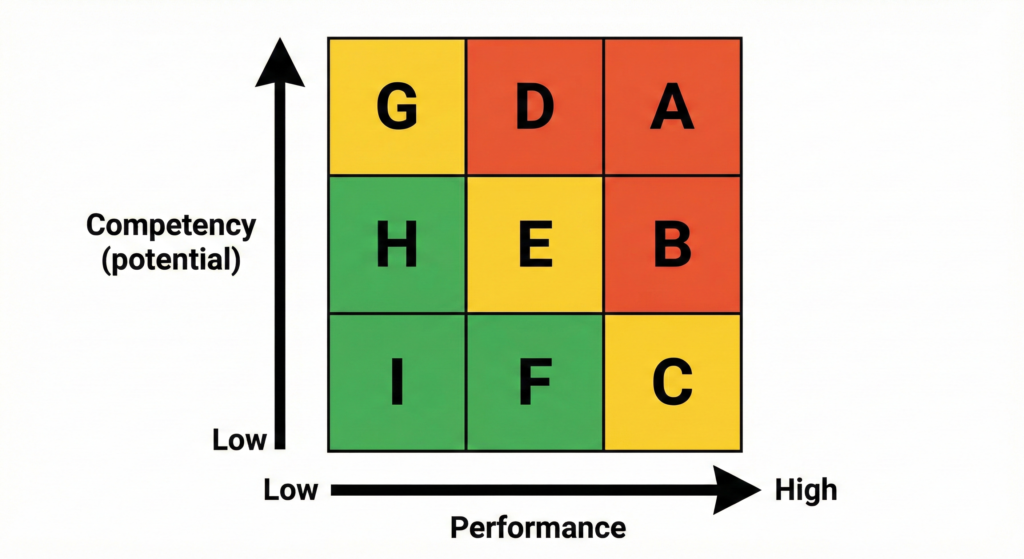
3. Holistic Evaluation via the 9-Box Grid
During the talent review, a standard 9-box grid is used to evaluate individuals across two core dimensions:
- Performance: Based on KPI attainment and the stability of outcomes over a period of time.
- Competency: Assessing the depth of ability, work methods, and future development potential required for the current job level.
Through the cross-analysis of these two dimensions, we gain a more comprehensive understanding of whether an employee has stabilized in their current role or is ready for the challenges of the next stage.
4. Promotion Evaluation: Assessing “Readiness”
Within this system, promotion is not the result of a single indicator, but a comprehensive consideration of the following factors:
- Whether performance expectations for the current job level can be met consistently over the long term.
- Whether the individual demonstrates competency maturity that meets or approaches the requirements of the next job level.
- Whether you have already assumed the corresponding role responsibilities and influence within your work.
Therefore, outstanding performance means that results receive immediate feedback; whereas promotion signifies readiness to take on higher-level roles and responsibilities.
5. Salary Adjustments and Promotions are Linked to Job Grade and Competency
The results of the talent review will be practically applied to several important personnel decision-making aspects, including:
- Salary Adjustment Evaluation: Assessing the possibility of salary growth based on review results and the salary range of the corresponding job grade.
- Promotion (Level Up) Evaluation: Assessing whether one possesses the competency maturity and role readiness required for the next job grade.
- Career and Role Development Planning: Serving as a reference for subsequent adjustments in work content, expansion of responsibilities, or the direction of competency cultivation.
- Development and Improvement Planning: Serving as a basis for training, competency reinforcement, or work support when necessary.
Through this system design, salary adjustments and promotions are built on a foundation of performance and growth over time, rather than ad hoc or isolated judgments.
6. Core Philosophy of the 9-Box Grid System
The purpose of the 9-box grid system is not about categorization or labeling, but about establishing a consistent, communicable evaluation framework to help the company and staffs align expectations.
The core philosophy of this system includes:
- Distinguishing between short-term results and long-term competency: Results are already addressed through quarterly feedback; the review focuses on competency and development potential.
- Evaluating the same job grade with consistent standards: Assessment benchmarks do not change based on job category, enhancing the fairness of the system.
- Providing clear grounds for development and adjustment: Ensuring that salary adjustments, promotions, and career development have explicit and understandable criteria.
- Establishing talent development and risk early-warning mechanisms: Enabling early identification of high-potential talent and timely provision of necessary support and adjustments.
- Fixed cycles to enhance stability and predictability: Ensuring employee’s clearly know how the system operates, when evaluations occur, and how they can prepare.