2026.01.23 / Benefit
Career Development System
Therefore, we established a comprehensive career development system—spanning from job classification and grade design to diverse development paths—to help employees understand their current positioning and identify potential directions for future growth.
I. Diverse Job Category Design, Mapping to Different Professional Roles
To reflect the nature and contribution of various roles within the organization, we classify positions into distinct job categories based on their professional attributes. Each category is defined by a clear role positioning and specific competency expectations.
The current primary job categories covered include:
- Sales
- Engineer
- Trainer
- Customer Support (CS)
- Marketing
- Human Resource (HR)
- Accounting
Each job category corresponds to a clear job description, role purpose, required skills, and core competencies, paired with appropriate performance indicators and salary ranges, ensuring that employees from different professional backgrounds can contribute their value in the right positions.
II. Job Grade System: Making Growth Standards Clearer
We use “Job Grades” as the foundation for career development, comprehensively considering:
- Complexity of work and scope of influence
- Degree of contribution to the organization
- Required professional skills and experience
- Responsibilities and level of decision-making
Through a clear job grade design, employees can understand the company’s expectations for different roles and identify the competencies and requirements needed to grow from their current position to the next stage.
This system ensures that career development is no longer vague, but rather a process that is traceable and allows for continuous accumulation.
III. Dual-Track Career Development: Parallel Paths for Professional and Management
Our career development system adopts a dual-track design featuring the Professional track (Individual Contributor, IC) and the Management track (Manager), ensuring that growth is not limited to a single path.
1. Professional (IC) Development Path | G1–G6
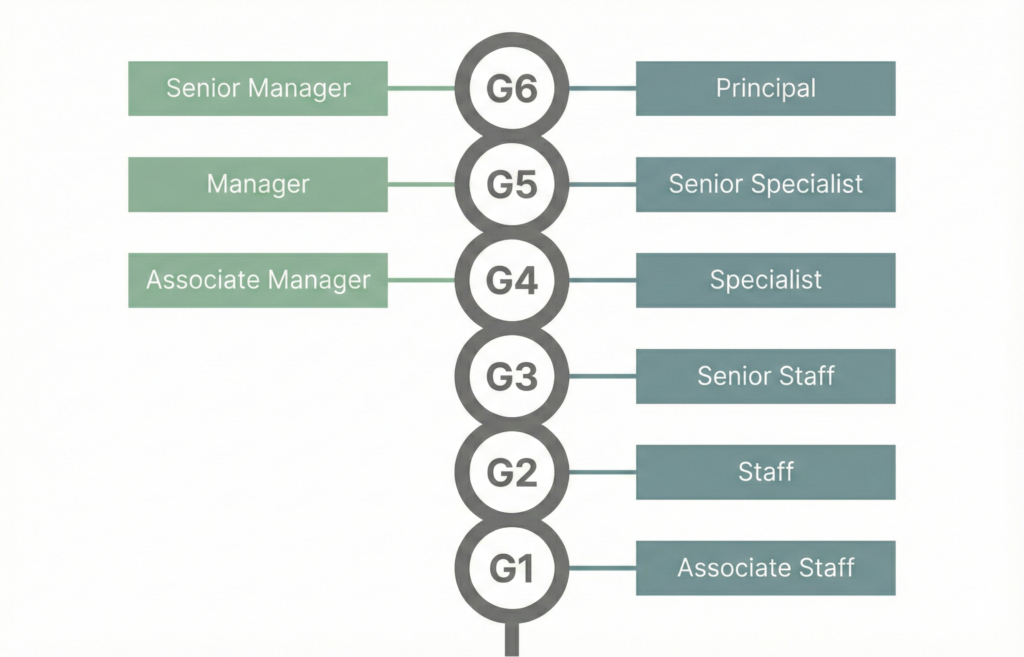
The professional track is divided into six job grades, categorized into two stages based on professional maturity and influence:
- G1–G3: Skill Cultivation × Stable Execution × Independent Task Completion
- G4–G6: Independent Thinking × Autonomous Planning × Leading Projects and Cross-Departmental Collaboration
In the professional career path, even without taking management responsibilities, one can continue to be promoted and receive corresponding rewards as their capabilities grow.
2. Management (Manager) Development Path | Diverging from G4
G4 serves as the divergence point between the professional and management roles. From this stage onward, employees can choose whether to transition to the management path based on their personal traits, current organizational needs, and development aspirations.
The focus of the Management role will no longer center on individual results, but rather on:
- Achieving overall goals through teamwork
- Bearing responsibility for team performance and outcomes
- Cultivating talent, delegating tasks, and making decisions
- Conducting cross-departmental communication and collaboration
This path is suitable for employees who are willing to commit to team leadership and organizational development, and corresponds to different skill expectations and responsibilities than professional positions.