2026.01.16 / Benefit
Compensation System
Within our personnel system, compensation is more than just a monthly salary; it is an integrated feedback framework based on job levels, individual capabilities, and measurable outcomes. This transparent design ensures that our employees understand their pay structure, the logic behind salary growth, and exactly how their contributions are fairly rewarded.
1. Compensation as a “Total Value” Proposition”
In the system, we view compensation as the “total value” provided by the company to its employees. It includes not only monetary rewards but also various resources that support work and development.
This perspective helps employees understand the feedback provided by the company from a more comprehensive standpoint, rather than focusing solely on the salary figure at a single point in time.
2. The Core Elements of the Compensation Framework
Total compensation can be broadly divided into the following two levels:
1. Monetary rewards
Includes compensation items directly related to the position and results, for example:
- Base Salary: Paid monthly on a fixed basis, reflecting job grade, job responsibilities, and competency requirements.
- Variable Bonus: Depending on the nature of the position, this may include sales-related bonuses or performance bonuses, which are linked to target outcomes.
- Year-end Bonus and Allowance: Annual bonus and various subsidies provided according to the system design.
2. Non-monetary value
In addition to monetary rewards, this also includes important resources that support work and growth, for example:
- Legal and supplemental insurance coverage
- Various types of leaves
- Education, training, and career development resources
- Stable, transparent, and consistent management systems and working environments
3. The Annualized Model: A Holistic View of Rewards
After understanding the complete composition of compensation, we use the concept of “annual salary” as a way to review the overall compensation structure.
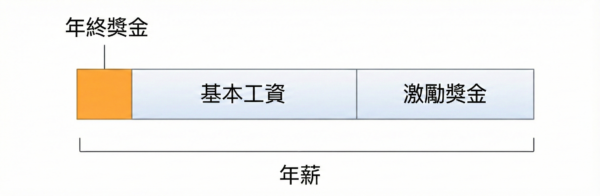
This approach allows employee’s to more clearly understand:
- The overall ratio between fixed salary and bonuses.
- Differences in compensation structures between different job grades
- The full picture of the total rewards provided by the company
Compensation represents the total value of rewards, while “Annual Salary” is the perspective we use to review it, helping to ensure the system remains clear and consistent.
4. Tailored Compensation Structures by Job Category
Depending on the nature of the position and the way it contributes to company operations, the ratio of base salary to variable bonus within the annual salary will vary for each job category.
- Job categories that are highly and directly linked to revenue results have a relatively higher bonus proportion to strengthen result-oriented incentives.
- Job categories focused on professional and operational support consist primarily of fixed salary, paired with moderate performance bonuses.
- For job categories that fall between the two, the compensation mix will fall within the middle range.
| Job Category | Fixed Salary Ratio | Variable Salary Ratio |
|---|---|---|
| Sales | 70% | 30% |
| Engineer | 80% | 20% |
| Trainer | 80% | 20% |
| CS | 80% | 20% |
| Marketing | 80% | 20% |
| HR | 90% | 10% |
| Accounting | 90% | 10% |
5. Structuring Pay Scales for Fairness and Career Projection
Each job category and grade corresponds to a clear salary range, including a minimum and maximum for that grade. The purpose is to:
- Ensure that salary is commensurate with the job grade.
- Establish clear and predictable room for growth.
- Avoid inconsistencies arising from individual or managerial subjectivity.
- Reflect the differences in responsibility and capability across different job grades.
In the design of salary ranges, there may be partial overlaps between adjacent job grades; this is intended to reflect reasonable differences in maturity within the same grade, rather than being an exception to the system.
When salary reaches the upper limit of the range for a given grade, it signifies that future growth will require a promotion in grade to enter a new salary range.
6. Comprehensive Salary Structures by Category and Grade
For different job categories and grades, the company has established corresponding salary range scales to serve as an important reference for recruitment, compensation management, and career development.
As the details of the salary ranges for each job category and grade are comprehensive, they have been organized into a separate article for explanation. Please feel free to view it here:
7. Aligning Compensation Growth with Professional Advancement
Overall, we hope the compensation system supports long-term development rather than short-term adjustments. Salary growth is linked to job grade, capability maturity, and role development direction, allowing employees to clearly understand how to accumulate long-term and stable rewards through capability enhancement and career growth.